
What It Is
Comfort the dog. Tell the kids dinner’s ready. Answer whoever just walked through the door. Out loud, in the room — from wherever you are.
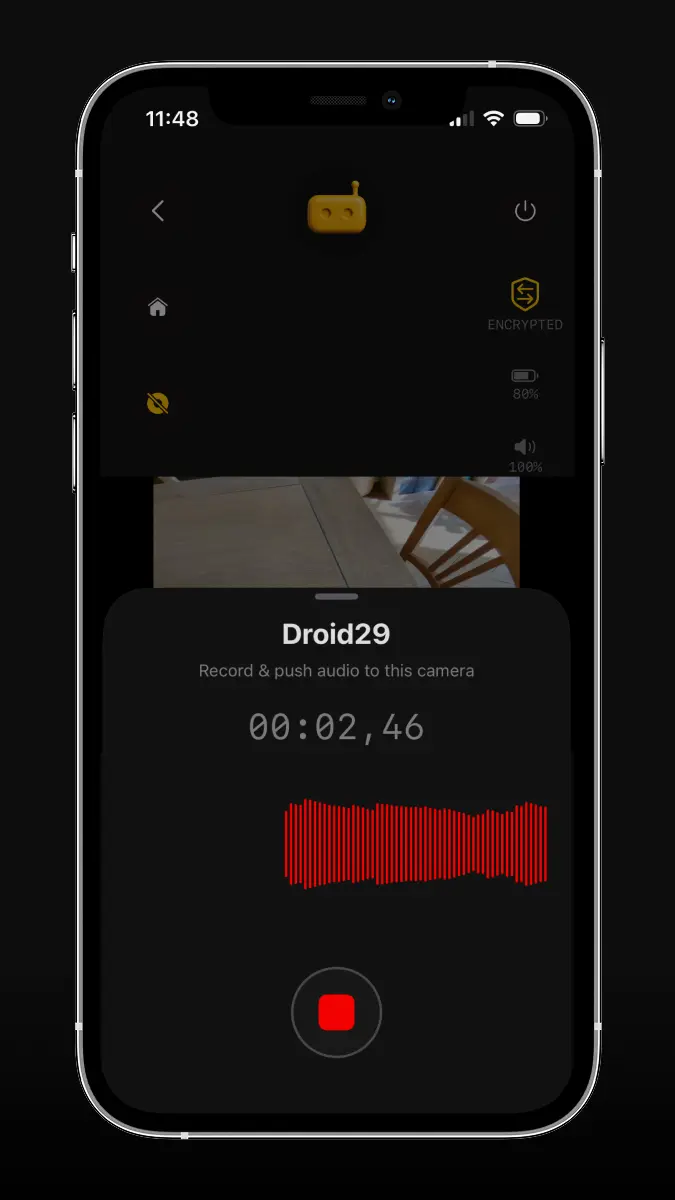
Open the live view and tap the mic. The capsule opens and recording starts at once — no countdown, no setup, no menu. Say your few words and tap the red stop to send them. Change your mind, swipe the capsule down; nothing goes anywhere. Thirty seconds is the ceiling, and it stops itself there.
How It Works
Recorded and delivered, not a live call — and that is the design, not a shortcut. The moment your message reaches the camera device, it plays through that device’s own speaker. Nothing rings first, nothing waits to be accepted, and nobody has to be standing there.
It plays at that phone’s current alarm volume — deliberately not forced to maximum the way the remote siren is. A whispered “go back to sleep” at eleven at night should not land as a shout. RECAM pauses its own sound detection while the message plays, so your own voice never sets off an alert. And you hear it land: the camera’s mic picks your words up in the live stream you are already watching.
Every message is end-to-end encrypted with AES-256-GCM, using a key derived from the camera’s own pairing secret — the same one that keeps the live stream private. Only devices paired to that camera can decrypt it. Our server briefly holds an opaque blob it cannot read, deletes it the moment the message plays, and drops it after 24 hours if nobody hears it. The audio is tiny — around 90 KB at most — and only scrambled audio ever leaves the phone. We can’t hear it.
Both Ways
The camera device has the same mic button. Tap it there and the message goes to everyone watching that camera. Anyone in the live view hears it straight away; anyone else gets a push notification — Voice message from <camera> — Tap to listen — even if RECAM is not open on their phone. Tapping it opens that camera and plays the message. Nobody has to be watching for a message to reach them.
Messages you haven’t heard gather on a single button with a badge count and play oldest to newest, so an exchange that happened while your phone had no signal still arrives in order.
One thing worth knowing: while the camera device records, its live stream pauses for those few seconds, then picks itself back up.
Why a Message Beats a Call
A call only works if somebody is there to take it. A message plays either way — into an empty hallway, at a dog who will never tap a green button, at a person whose hands are full.
The rest follows from that. Nothing rings, so nothing wakes the house at the wrong moment. There is no echo and no feedback squeal, because your phone mutes the camera’s live audio while you record — your voice has nowhere to loop back through. And thirty seconds turns out to be generous for the things people actually say through a camera: dinner’s ready, shh, go back to sleep, I can see you — leave, hi Mum, it’s me, I’ll ring you at six.
That covers most of why people set a spare phone up at all. Watching a crib with an old phone as a baby monitor, a few words in a voice the baby already knows settle things faster than any lullaby track. Checking in on a parent who lives alone, you can say good morning without asking them to find a handset first. And left with the dog, “basket” still works from another country.
With the Siren
If the remote siren is already wailing and a message comes in, the siren pauses, your message plays, and the siren picks up where it left off. So I can see you. Leave. is heard over the alarm instead of under it. Neither one ever fires by itself: a detection never triggers a siren or a message. You look, you decide, you tap.
The Honest Limits
- Thirty seconds a message. It is a recording, not a live call — if you want a conversation, phone them.
- The camera phone has to be on camera duty. Screen off on its charger is fine, but a message sent to a camera that is off or paused is never played, and it expires unheard after 24 hours.
- Both devices need the current RECAM. The mic button only appears in a live view once the camera device can receive voice messages.
- It is never automatic. Like the siren, your voice goes out because you decided to send it. A detection can never speak for you.
Getting It
Push to talk is part of RECAM Pro — $4.99/month or $49.99/year. Try it free: the yearly plan starts with a 3-day free trial of every Pro feature, then $49.99/year; cancel anytime. The same subscription covers the remote siren, unlimited sharing, smart sound and motion alerts, and clip replay from anywhere. Sending from a viewer needs Pro; for the camera device to talk back, the camera’s owner needs Pro. The spare phone in the hallway never needs a subscription of its own.
The phone or the Mac you left at home can speak for you now.
Download RECAM — free to start, no sign-up.